Friday, June 26, 2009

Ten things that define Delhi (7)

If you're like me, and you love all things green, then Delhi can be a delightful city. Just driving along can be a pleasure, with wide tree-lined avenues, each home to many varieties of trees. .
Delhi, City of Trees
Tamarind, jamun, neem, pipal, banyan...all of them provide shade in the Delhi summer, and are refreshingly green in the rains. And it's not just trees - there are parks and gardens, beautiful restful places where you can sit down and enjoy the peace.
.
Yes, that is indeed a peacock strolling by casually
.
Gorgeous greenery at the Hauz Khas tank
.
There are many large garden areas - the beautifully landscaped Lodhi Gardens, the Mughal Gardens at Rashtrapati Bhavan, Buddha Jayanti Park, the Zoological Park, Nehru Park, the Delhi Golf Club...these are home to over 250 species of trees.
.
But although the large public gardens and parks are lovely, for me, the real heart of Delhi is in the small gardens that dot residential 'colonies'. In these gardens, the elders of the community come for their morning walks, some walk their dogs, some jog, and the children play cricket in the evenings. There are small benches where recipes are exchanged, gossip traded, matrimonial matches made, and much knitting accomplished. I still remember one summer morning when I sat on a porch with my chai, idly looking at the flowering trees of the neighbourhood garden. The coral tree was in bloom, and I watched the mynahs and sparrows hopping around chattering to themselves...what a blissful way to start the day.

- Deepa

P.S. Okay, now that I have defined seven ideas, how about suggesting what 8, 9 and 10 should be?

Thursday, June 11, 2009

Ten things that define Delhi (6)

A very Mughal city

Humayun’s Tomb in Delhi – a relaxing Char Bagh-styled Persian garden area that served as the inspiration for the Taj Mahal

To me, Delhi has always been the city of the Great Mughals.
.
Babur, the first Mughal Emperor, was descended from the Mongol invader Ghengis Khan on his mother's side and on his father's side the infamous Timur (Tamberlane). The word Mughal itself is derived from the word Mongol.
.
Babur was succeeded by his son Humayun in 1530. But Humayun was only 22 and soon lost his territories to the Afghan Sher Shah Suri. He regained them with Persian aid ten years later, returning with a large retinue of Persian noblemen.
.
Humayun's return with a Persian entourage signalled an important change in Mughal Court culture. The Central Asian origins of the dynasty were now largely overshadowed by Persian art, architecture, language and literature.
.
The Persian influence is still visible today, not only in the monuments of Mughal Delhi, but also in the Urdu language and Mughlai cuisine of Delhi.

Thursday, May 7, 2009

Ten things that define Delhi (5)

.
.Dilli ki shaan - The Metro!.

The Metro is more than just a Mass Rapid Transit System. It is proof that change can happen, that things can work, that a few good bureaucrats can make a giant difference. Take a Metro ride today!

Wednesday, May 6, 2009

Ten things that define Delhi (4)

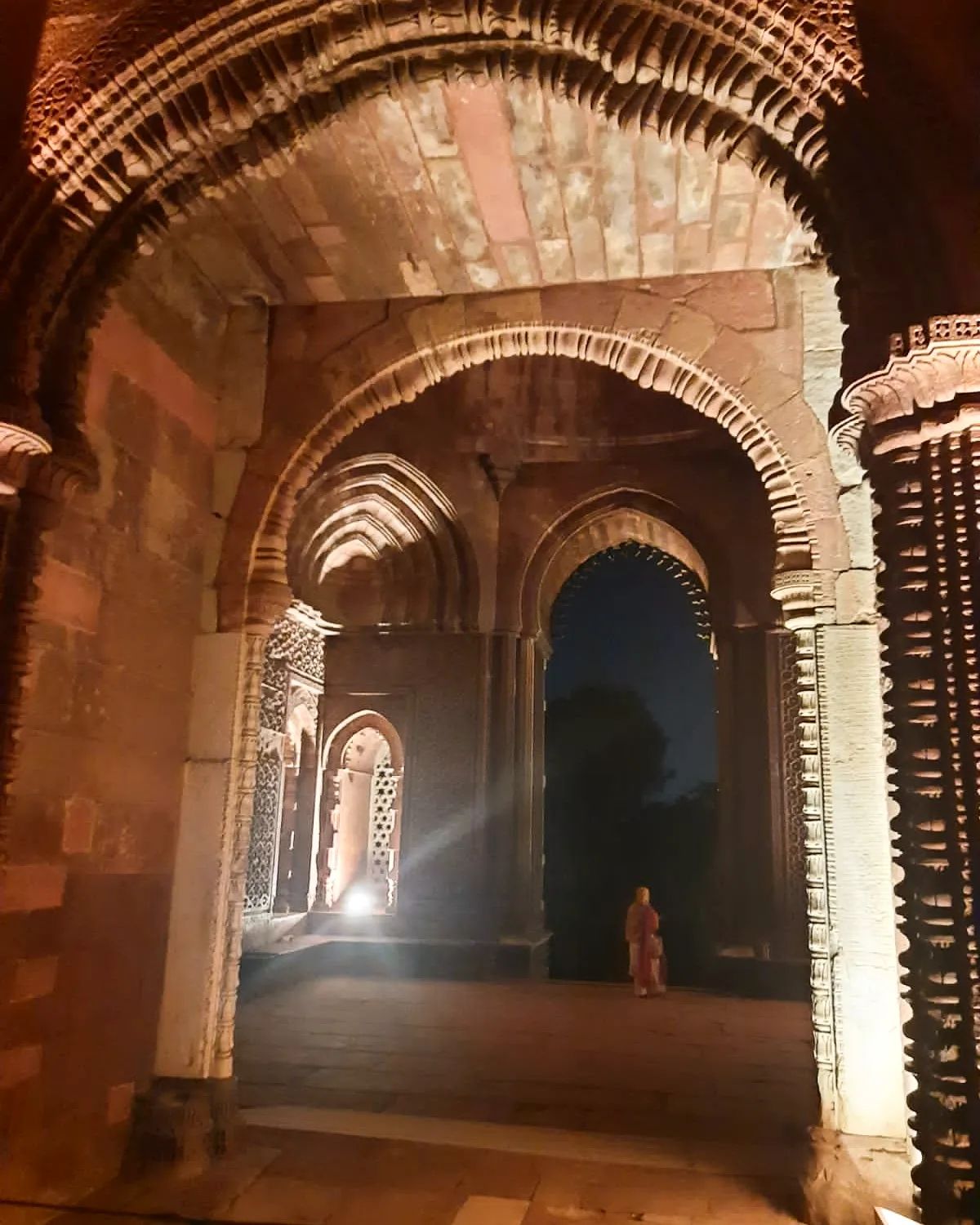
The Qutb Complex - a place where history comes alive.

The Qutb Complex is a UNESCO World Heritage site that marks the arrival of Islamic rule in India. Built by the Slave Dynasty who ruled India for nearly a century, the complex is a grand cultural statement marking the beginning of a new religion that transformed the country.

In the initial phases, the new rulers demolished Hindu and Jain temples, but reused the pillars and stones, creating structures unique in the Islamic world. Later, Hindu craftsmen and artisans learnt how to work within the Islamic artistic framework. In the Qutb Complex, the lucidity and economy of Islamic architecture meets with the richness and exuberance of Hindu art, to form beautiful and arresting structures.

Go see the pillars of Quwwat-ul-Islam (Might of Islam), the first mosque in North India, and you'll feel like you're in the middle of a dramatic story.

Saturday, April 25, 2009

Ten things that define Delhi (3)

Number three on my list (perhaps it should have been number one?)

Food ! Finger licking, scrumptious, fattening food!

Whether it is hearty butter chicken, Moghlai cuisine or just roadside chaat, Delhi truly has some amazing food on offer.

This photo is of a very 'standard' meal - butter naan, paneer in butter and tomato gravy, and buttery daal (yes, everything has butter or ghee!). Washed down with a tall lassi.

This is the kind of meal where at the end of it, you sit back a little glassy-eyed and look at the world in a very kindly sort of way.

Monday, March 30, 2009

Ten things that define Delhi (2)

.
But of course, Delhi is all about its women - the gorgeous dilliwallis.
.
The girls of Bombay may have that oh-so-cool attitude, but it is the women of Delhi who have made formal dressing into a fine art.

I was sitting at the bar at the Maurya Sheraton with two English colleagues a couple of years ago, when we saw a high profile society wedding in the hotel. For nearly an hour, as the who's who of Delhi came for the wedding, the three of us just sat there fascinated. We saw what must be some of the most beautiful women in the world, wearing some of the most outstanding wedding costumes ever designed.

That evening has become one of my enduring images of Delhi. All those gorgeous women, swishing past in exquisite wedding lehengas, expensive jewellery, fancy purses, and stilettos...it was Delhi at its swankiest best.

Sunday, March 8, 2009

Ten things that define Delhi - (1)

Here's the first one:

All those glorious government buildings

(And outside them, the white Ambassador cars of the babu-log!)

Raisina Hill and it's surrounds are the most visible symbol of sovereign India. When someone says "The Indian Government", I'm guessing many of us see visions of Rajpath, Janpath, North Block, South Block, Parliament House, and so on.

I don't know about you, but this is an image that evokes mixed reactions in me.

On the one hand, there is pleasure at the image of broad roads and beautiful buildings. On a sunny day, you walk up Raisina Hill and see Rashtrapati Bhavan or the Secretariat silhouetted against a blue sky...the breeze blows through your hair and you feel like you're on top of the world.

On the other hand, there is despair at not being able to change the slow-moving and corrupt system. Through its sheer size, the bureaucracy towers terrifyingly over me; I feel dwarfed and impotent. It is like a mysterious machine that wields enormous power. The machine is inexorable, it holds the lives of a billion people in its palm...it grinds on, driven entirely by political intrigue and favour-trading.